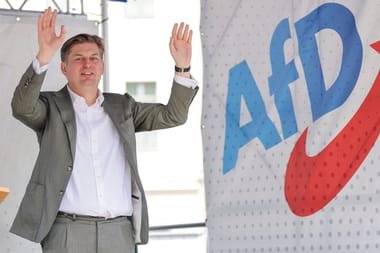
AfD top candidate Maximilian Krah announced he will stop EU election campaigning following spy and corruption allegations — and a recent comment about the Waffen-SS.
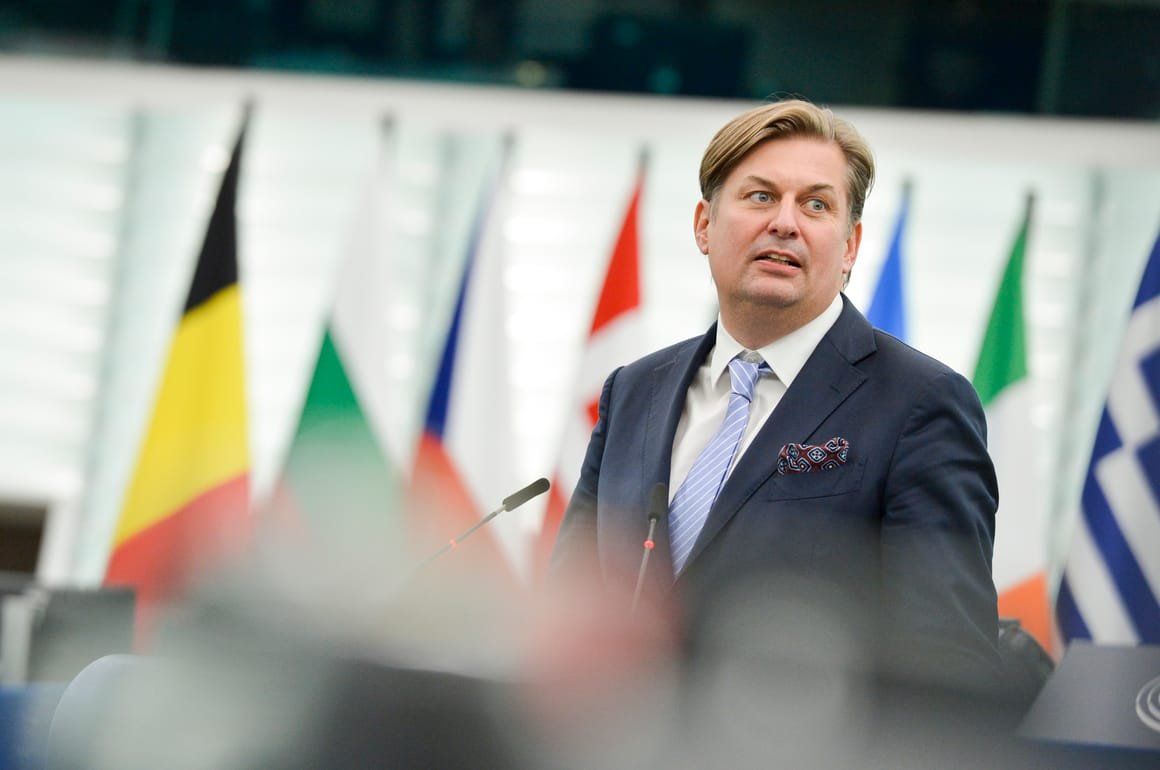
Maximilian Krah, the scandal-plagued lead candidate in the EU election for the far-right Alternative for Germany (AfD) party, announced Wednesday that he will stop campaigning and step down from his party’s leadership board — even as he technically remains the party’s top candidate ahead of the EU election.
Recent statements of his “are being misused as a pretext to harm our party,” Krah wrote on social media. “The last thing we need right now is a debate about me. The AfD must maintain its unity.”
Krah’s announcement came a day after France’s National Rally, the party of Marine Le Pen, said it wouldn’t sit alongside the AfD party in the next European Parliament.
The French decision followed an interview with Krah in the Italian daily La Repubblica in which the AfD lead candidate said he would “never say that anyone who wore an SS uniform was automatically a criminal,” a reference to German novelist Günter Grass, who admitted late in his life to having joined the Waffen-SS as a teenager.
The French far-right isn’t alone in distancing itself from Krah. Anders Vistisen, a Danish far-right MEP whose party is also in the ID group, called on the AfD to “get rid of Krah” or to leave the group altogether.
The internecine conflict appears to have forced AfD leaders to stop Krah from campaigning ahead of the EU election. But Krah technically remains the AfD’s top candidate no matter how badly the party’s national leaders wish to see him go for the simple reason that it’s too late to remove him from the ballot, creating a quandary for party leaders.
“He is effectively no longer a top candidate,” a spokesperson for Alice Weidel, one of the party’s national leaders, told POLITICO.
But for the AfD, Krah is a problem that won’t easily go away.
The party has been beset by one scandal after another in recent months, contributing to a slide in polls, with much of scrutiny involving Krah.
In April, German police arrested one of Krah’s parliamentary aides over allegations he spied for China. Shortly after that, German public prosecutors in the city of Dresden initiated preliminary investigations over allegations that Krah had accepted payments from Russia and China “for his work as an MEP. Earlier this month, Belgian and German police conducted a search of Krah’s European Parliament office in connection with the espionage investigation.
In response to the spy allegation, the AfD’s national leaders decided that he should take a lower profile in the campaign in order “not to damage the election campaign or the reputation of the party.”
But Krah continued to attend campaign events in recent days, including a bizarre apperance in Bavaria in which he appeared with a Jaguar convertible along with two models in dirndls waiving German and AfD flags.
The recent announcement suggests there will no more such events for now, but a source close to Krah suggested he will be able to take a more prominent role again after the EU election.
The withdrawal from campaigning and resignation from the board were about “maintaining peace within the party” until the scrutiny dies down after the EU election, said a person close to Krah, who spoke on condition of anonymity to talk freely about sensitive party matters.
Krah is also likely to keep his parliamentary seat after the election.
“He does not want to resign his mandate,” Weidel’s spokesperson said. “However, he will not play a prominent role in the delegation.”
For Le Pen, the attempt to distance herself from the AfD appears to be part of a larger strategy to make her party appear less extreme in an attempt to win over voters at home and realize her ultimate aim — to win the French presidency.
In recent months, she has repeatedly distanced herself from the AfD, which has grown increasingly radical in recent years, in an apparent attempt to help transform her party’s image.