

Rishi Sunak positioned the U.K. as a world-leader on AI safety. Keir Starmer is adopting a more boosterish stance.

LONDON — Keir Starmer came to power promising to kickstart economic growth, reform public services and boost living standards.
With the economy in the doldrums, he’s optimistically banking on artificial intelligence to do all three.
In a speech on Monday, Starmer will unveil an “AI Opportunities Action Plan,” a copy of which was first obtained by POLITICO on Friday. “There is no route to growth without embracing the transformative potential of AI,” Starmer writes in the foreword, pledging that delivering the plan is a « top priority » for him.
A breathless government press release reads: “Today’s plan mainlines AI into the veins of this enterprising nation,” arguing the plan will make Britain “irresistible to AI firms.”
It’s a far cry from the safety-first approach to AI taken by his Conservative predecessor Rishi Sunak — and comes as Donald Trump prepares to weaken AI guardrails his predecessor was busy building.
So what’s in the plan — and what’s the British government thinking?
Written by entrepreneur Matt Clifford, the document’s 50 recommendations include setting up AI “growth zones”, increasing public sector access to compute 20-fold and building British “national champions” in frontier AI.
Under Sunak the U.K. sought to position itself as a world-leader on AI safety. He persuaded Clifford, the government’s go-to tech brain, to help organize an international safety summit at Bletchley Park in November 2023 — with Elon Musk given star billing.
But under Labour, whose tech secretary is influenced by think tank the Tony Blair Institute’s boosterish views on AI’s potential, Clifford was brought back with a very different brief.
National champions
The AI Opportunities Action Plan seeks to chart a course for Britain to succeed in the global AI arms race.
“We need companies at the frontier that will be our U.K. national champions,” it reads and urges the government to use “all the levers of the state”, to make it happen.
The government will partner with “national champions” at the frontier of AI, giving them access to public sector datasets and compute, support them with visas, and build their relationships with national security agencies.
The government will also earmark brownfield sites, already connected to the energy grid, as new “AI Growth Zones”.
The first is Culham, Oxfordshire, home to the U.K. Atomic Energy Association. Those sites will host large data centers, with Culham earmarked for one of the biggest in Britain at 100 MW, when a private sector partner is found. Further sites should follow this year with the idea that clusters of AI companies should grow up around those zones.
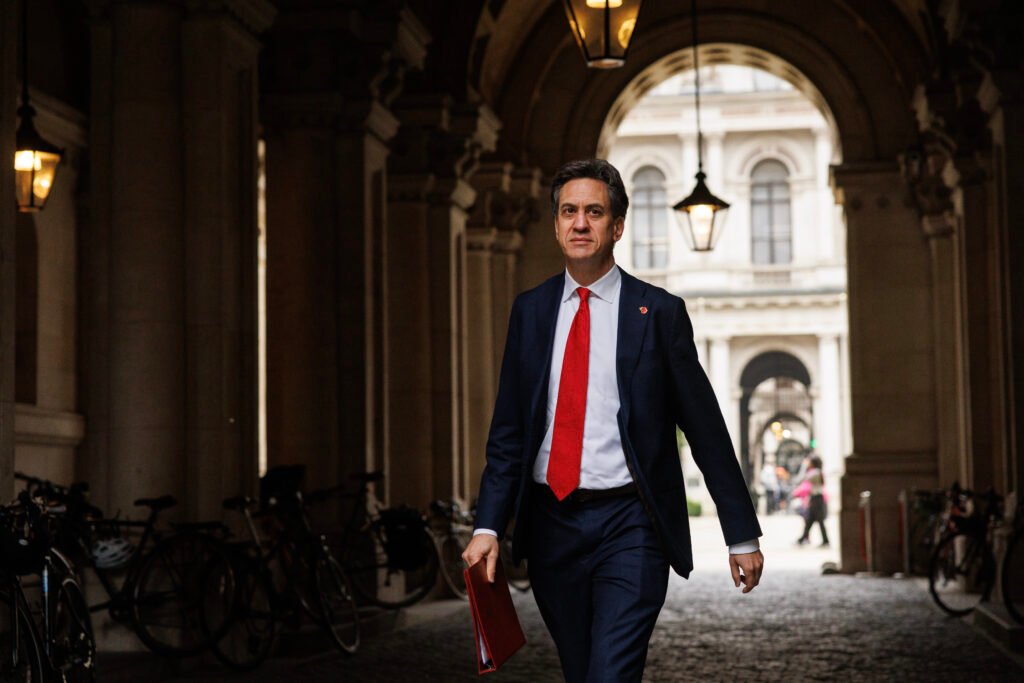
An AI Energy Council is also being formed, headed by Energy Secretary Ed Miliband and Tech Secretary Peter Kyle to find solutions to AI’s ever-increasing demand for power. They’ll look at renewables and small modular reactors.
The plan also aims to increase the country’s public sector compute capacity by a factor of 20 by 2030. To do that, the government will commission a new supercomputer.
Ministers will fully accept 48 of recommendations, according to three people familiar with the government’s response to the plan, which comes on Monday morning.
The remaining two will only be partially accepted. One of those is around visas, with Clifford calling for an institution in India and the U.S. to be added to the High Potential Individual visa scheme.
The second is said to be around intellectual property. Clifford suggests creating a dataset from British institutions, like the BBC and National Archives, which can then be licensed globally to train models.
Other ideas are to use the state’s buying power to stimulate innovation, scale public sector AI pilots and appoint “AI Champions” for the eight sectors in the country’s industrial strategy.
Julian David, chief executive of industry body TechUK described the plan as “well thought out”, but added: “It is time to act, and at pace.”
Trump’s shadow
The tech industry is also closely watching for the government’s next move on regulating the cutting-edge tech.
The plan argues that the government should better equip existing regulators — but Labour wants to go further.
Ministers have promised to introduce an AI Regulation Bill, with a consultation coming “shortly,” the government said on Friday.
That will be an early test for U.S. tech companies emboldened by the prospect of Trump’s second presidency — and for British diplomacy.
Trump has already said he would revoke an order by the Biden administration to govern AI and would wind down some of the work on AI safety by government agencies which work closely with the U.K. AI Safety Institute.
“I suspect the new administration is likely to push back against attempts by other jurisdictions to compel access to U.S. technology or intellectual property,” Ben Brooks, a fellow at Harvard’s Berkman Klein Center For Internet & Society, told POLITICO last year.
“That includes any mandatory evaluation or disclosure requirements tabled by the U.K. government.”
A bigger battle lies ahead.