Leaders are negotiating their response to the U.S. president’s tariff threats.
BRUSSELS — Europe’s leaders are searching for an offering to get U.S. President Donald Trump to spare the EU from his global trade war — and that could mean provoking a battle with China.
Trump last week threatened to make good on his campaign promise to slap 25 percent tariffs on Mexico and Canada, before walking back on the threats on Monday after securing border-related concessions from both countries. Meanwhile, he threatened to impose a 10 percent levy on Chinese goods.
The EU worries it could be next. Over the weekend, Trump called the bloc an “atrocity” on trade.
As a way of wooing Washington, pressure is building within the EU to harden the bloc’s trade stance toward China. It’s a wager that taking on Trump’s biggest foe will keep Europe out of the tariff firing line.
Just last week, EU trade chief Maroš Šefčovič floated the idea of teaming up with Washington to “deal with the joint challenges coming from China’s non-market policies.” It was the first time Brussels has explicitly linked its policy toward Beijing with an effort to keep Trump on side.
Despite Trump’s recent actions, there is still a preference in Brussels for sticking with the alliance with America.
“If the U.S. starts a trade war, then the one laughing at the side is China. We are very interlinked, we need America and America needs us as well,” said Kaja Kallas, Europe’s top diplomat, on her way into a meeting of European leaders on Monday.
But opening a front against Beijing could be a dangerous miscalculation as it might undermine Europe’s credibility in future negotiations and fracture EU unity, warned Agathe Demarais, senior policy fellow at the European Council on Foreign Relations.
“Given the high level of divergence across EU member states on how to approach relations with Beijing, there is virtually zero chance that the bloc could adopt measures that would prove strong enough to appease Trump in the field,” said Demarais, adding that the EU’s policies “are unlikely to impress Trump much.”
EU countries have widely different approaches toward China. Lithuania was hit by a Beijing boycott for maintaining relations with Taiwan, while Germany is deeply entwined despite the bloc’s overall strategy of de-risking by lessening dependence on China.
China is the EU’s second-largest trading partner, just after the U.S., with bilateral trade reaching €739 billion in 2023; Germany accounted for €250 billion of that.
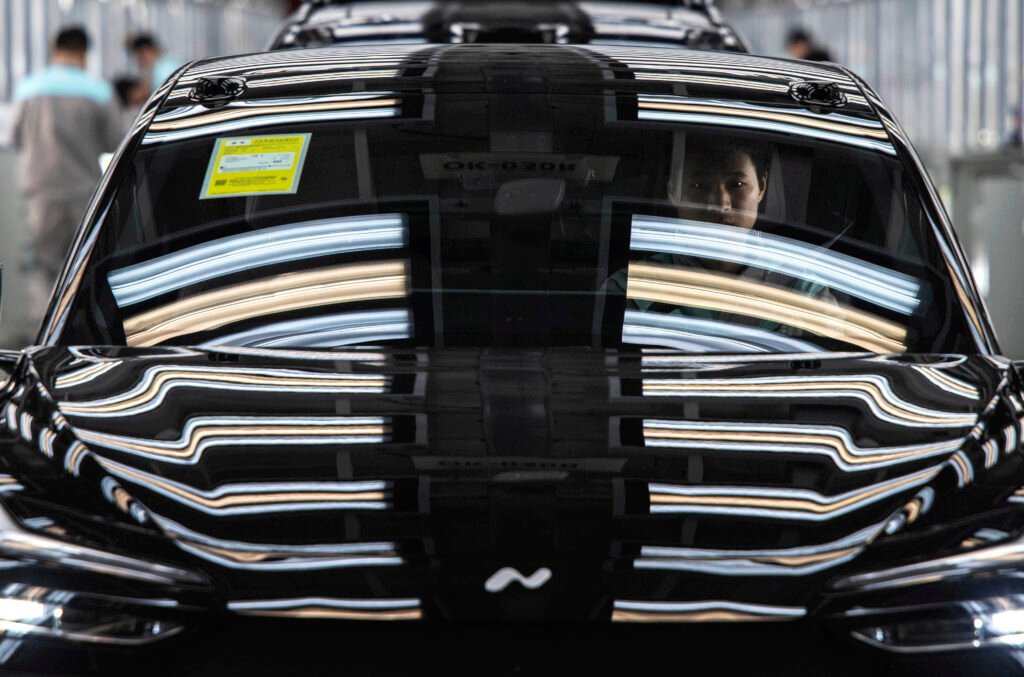
That’s led to big problems in holding a unified stance against China. When the European Commission slapped duties on made-in-China EVs last year, Berlin led a coalition of countries with strong industrial ties to China in a failed effort to block the duties.
Rather than rush to join Trump in bashing China, the bloc should “keep quiet but build up counter-measures,” said François Godement, a resident fellow on the U.S. and Asia at the Paris-based Institut Montaigne think tank.
“Don’t counter-provoke because that would only feed the public social media mud-slinging contest,” he said, particularly given the power Trump ally and adviser Elon Musk has as the owner of social media platform X in swaying public discourse.
“Don’t insult and don’t grandstand.”
Ketrin Jochecová contributed to this report.