



The Brits, French, and Germans all have their own ideas about how to defend the continent with America’s plans in flux.
Live coverage from Munich: POLITICO is on the ground at the Munich Security Conference, where we’re having conversations with top officials, lawmakers and experts at our POLITICO Pub. Follow our exclusive coverage here.
MUNICH — European officials say they get Donald Trump’s point: They need to take care of their own defense — with less help from the Americans.
But on the sidelines of the Munich Security Conference this weekend, few European allies were raising their hands.
It was the central question swirling through the crowded halls at the Hotel Bayerischer Hof: Who will be the continent’s security provider if the U.S. military scales down its presence — or simply packs up and leaves.
“Who is that person?” said Giedrimas Jeglinskas, chair of the National Security and Defense Committee in Lithuania’s parliament and a former NATO official. “You need to have some sort of hard power behind you to be really sitting at the table now.”
Germany has the continent’s largest economy, but the jury is out on Berlin’s latest defense plans until after this month’s election. The United Kingdom has taken over the Ukraine Defense Contact Group — at least for now. Poland now has the alliance’s third-largest military, behind only the mercurial Turks and the United States. Italy is leading NATO’s Allied Response Force.
The shifting relationship comes at an extraordinary moment for the continent. As Russia’s war in Ukraine grinds on, allies on NATO’s eastern front are watching in real-time as battlegroups swell to brigades.
The alliance has begun altering its defense plans to reduce the share of military assets it gets from the United States and move the burden toward Europe, a NATO official said. European militaries are expected to be able to field a corps-sized element of 20,000 to 45,000 troops, akin to the U.S. Army’s Fifth Corps that has a headquarters in Poland.
Paying for defense
Defense budgets, meanwhile, are going up. NATO’s defense spending target is moving from 2 percent of GDP to “considerably more than 3 percent,” the alliance’s chief, Mark Rutte, told POLITICO.
The U.S. has 80,000 troops in Europe, a number that’s jumped by more than 25 percent since Russia’s full-scale invasion of Ukraine three years ago. The European pillar of NATO and the U.K. spend about $460 billion per year on defense, about half of the Pentagon’s budget.
Visiting the alliance this week, U.S. Defense Secretary Pete Hegseth said American troops were in Europe for now but that “what happens five or 10 or 15 years from now is part of a larger discussion.”
It wasn’t hard for most Europeans to read between the lines. “It’s clear where the United States is. It’s not in Europe,” said a former NATO official, who like others was granted anonymity to speak candidly about dynamics within the alliance. “Europe is going to realize, ‘Holy shit, we’re on our own.’”
At the Munich conference, those debates dominated the event — from the first floor bar to the mezzanine coffee shop in heated pull-asides among diplomats, national leaders and security officials, all trying to make some sense out of the Trump administration’s mixed messages this week.
The debates are so urgent that French President Emmanuel Macron called an emergency meeting of leaders in Paris on Monday, indicating his desire to be a leader on a continent desperately searching for direction.
Ahead of NATO’s annual summit in The Hague this summer, the alliance is going to each of its members to scale up an ambitious new rapid response force that could send 100,000 troops to respond to a Russian attack within 10 days, and up to 500,000 within six months — far beyond anything the British, the French, or the Germans can do on their own.
“Nations are now being asked to put up,” said former U.S. Ambassador to NATO Ivo Daalder. “It isn’t like the Germans will step up and will do what it takes. It is, how are we collectively going to do that?”
One security official from a NATO ally said they could see a combination of the U.K., Denmark and the Netherlands all playing bigger roles, as they’re longtime alliance members which have supported Ukraine and increased their own defense spending.
Another lawmaker from a NATO country also said the U.K. is the obvious contender to play a bigger role in guiding the alliance, noting that Defence Minister John Healey already took over leadership of the Ukraine Defense Contact Group last week, the first time in three years the monthly meeting wasn’t chaired by the U.S. defense chief.
Hunting for soldiers
But the United Kingdom and European militaries don’t have enough troops to fill the gap if the Trump administration orders a large-scale withdrawal from the continent. They may have an even bigger challenge stepping up with sophisticated weapons systems, such as long-range missiles and air defenses.
NATO would probably have to defend the continent by committee, much as it did with Ukraine.
“I think it’s going to have to be a conglomeration, as I say to them, there’s some safety in numbers,” said Democratic Senator Chris Van Hollen. “It doesn’t have to be everybody. You’re not going to get Hungary, right? But you’re going to have to have some of the major countries — France, Germany, the U.K., but also in combination with the Netherlands and Belgium.”
NATO is heavily dependent on two American-led military headquarters to deter a Russian attack. And the nations are perhaps even more reliant on the U.S. military being able to send troops across the Atlantic Ocean in the event of a European war.
“It is critical that Vladimir Putin still believes in Article 5, and he does,” said a second NATO official, referring to the group’s collective defense pact. “I don’t think we have any reason to believe the United States isn’t committed.”
But some European leaders say they welcome the chance to step up.
“The new administration is posing some tough questions to us, and this is a chance for us also to step up and do more,” said Pål Jonson, the Swedish defense minister. “This is no beauty contest of leadership or anything like that.”
One European official agreed that the NATO alliance has to take a hard look at itself and do more on both funding new weapons purchases, and making sure its militaries are ready.
“We have to put together a coalition of the willing inside NATO,” that can act as a real deterrent force for any possible new Putin adventurism on the continent.
There is a sense, the official said, that Putin will not launch any new wars during a Trump administration, giving the alliance a four-year window to further prepare to deter Moscow.
But the Trump administration already seems to be playing favorites among the Europeans.
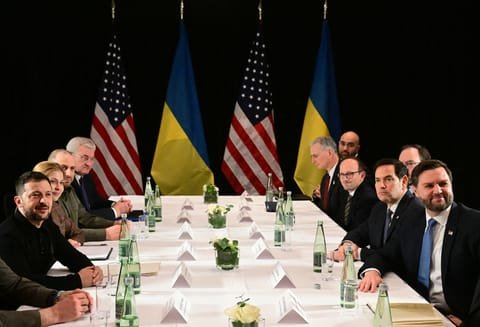
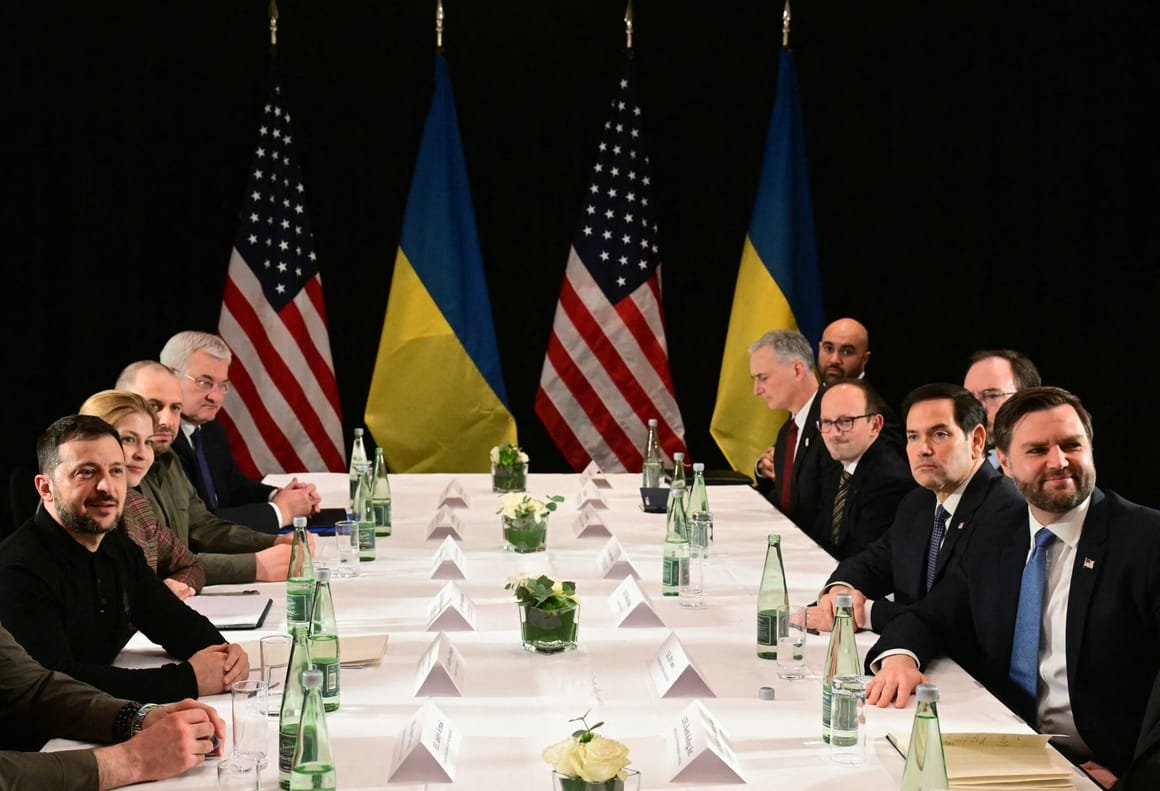
That was evident on Friday, when Vice President JD Vance opted not to meet with German Chancellor Olaf Scholz in Munich and gave Romania and Germany a stern talking to in his keynote speech. Hegseth, on a visit to next-door Poland, called Warsaw, which is set to spend 4.7 percent of GDP on defense this year, a “model ally. »
Unlike European officials, some of Trump’s allies in Congress — even those who don’t see the Americans pulling back from NATO — do seem to see the contest for European military leadership as more of a beauty contest.
“Europe should make themselves the most desirable partner,” said Republican House Foreign Affairs Chair Brian Mast. “Each individual country should make themselves the most desirable partner by not just saying, ‘I want to reach a number,’ but by making themselves a dominant force.”
Will any European country answer the call?
“We’ve been talking about wakeup calls for some time,” a German official said. “We keep hitting the snooze button.”