Hungary’s veto power could become meaningless under plans being drawn up by a group of capitals.
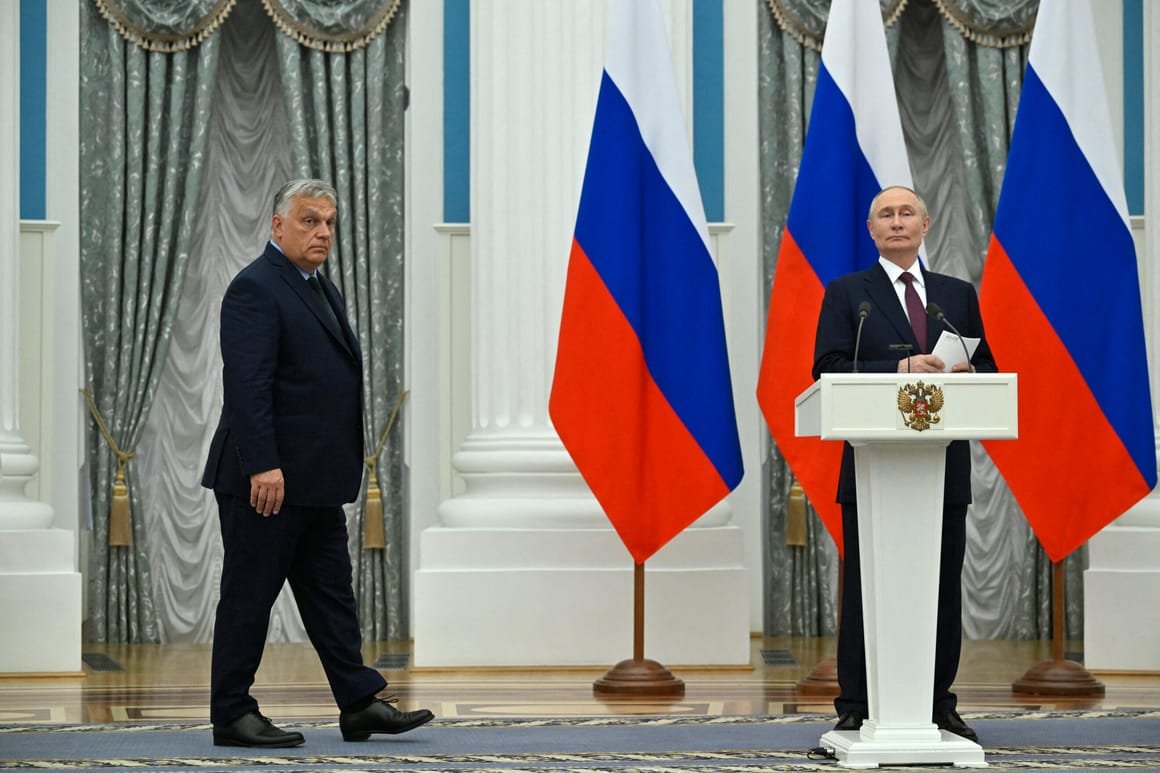
BRUSSELS — A handful of EU governments believe they’ve hit on a solution to prevent Hungarian Prime Minister Viktor Orbán from vetoing Russian sanctions — by making them national decisions that don’t need a European consensus.
Six diplomats confirmed a joint effort advocated by at least half a dozen capitals to transpose EU-wide Russia sanctions into domestic law. In effect, this could undercut Hungary’s ability to veto their renewal — currently, rolling the measures over requires the bloc’s unanimous support every six months.
“We all — member states and institutions — need to be in the mindset where we know it’s possible sanctions won’t be renewed, » said one of the diplomats, granted anonymity because of the confidential nature of the discussions. « We have to make sure the whole sanctions regime is resilient. »
Significantly, those considering the move include nations that in the past have been reluctant to impose restrictions outside the EU umbrella, such as Belgium and the Czech Republic.
While not all governments are expected to sign up to the idea, if several key countries followed through it would limit the impact of any future Hungarian veto.
Only a handful of frontline nations bordering Russia have so far introduced unilateral sanctions, but diplomats confirmed that a broader range of capitals were now thinking of implementing their own measures.
Orbán has repeatedly threatened to use his veto, thereby holding unrelated EU initiatives hostage. He has vowed to block measures against Russian oil, gas and nuclear technology — despite warnings that a return to buying sanctioned Russian energy would be a fatal mistake.
In January, a high-stakes drama saw the Hungarian delegation refuse to approve the renewal of restrictions — coming within hours of allowing billions of dollars to flow back to Moscow. U.S. Secretary of State Marco Rubio privately urged Budapest to back down, and the rollover was ultimately approved.
Shaking the foundations
Europe’s foreign ministers met on Monday in Brussels to prepare a new round of EU-wide restrictions, the 17th to be imposed on Moscow since its full-scale invasion of Ukraine in February 2022.
Hungary’s refusal to sign off on the conclusions regarding Russia’s war against Ukraine at the last gathering of European leaders in March sparked renewed debate about how to deal with Budapest’s opposition to key planks of EU policy.
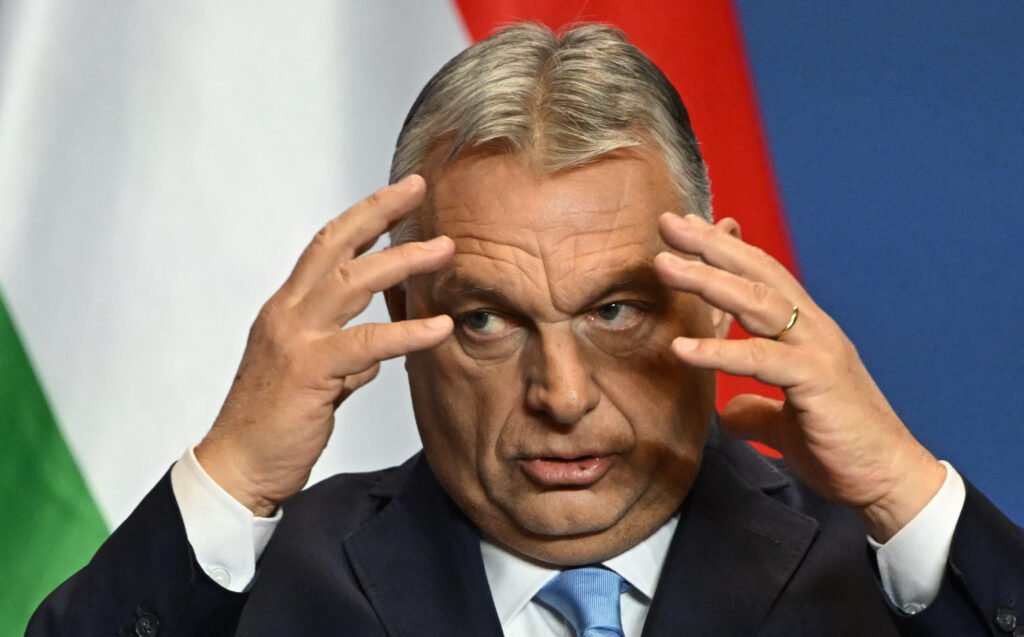
« Yes: If our usual suspect [Hungary] is creating a huge problem then there will be ways to go around that, » a third EU diplomat said. « I can say that if the certain member state were to do this [try to block the sanctions rollover] that would be a very serious situation. »
Germany’s incoming ruling coalition is also advocating a tougher approach to countries that violate the rule of law in the EU, including possibly removing their voting rights — a provision that appears aimed at Budapest.
However, capitals remain split on how that could work in practice.
While some EU diplomats view the plan to shift important policymaking from Brussels to the national level as far more practical, Ukraine’s allies in Europe are hesitant to make any moves that could undermine a common front — especially in the face of U.S. President Donald Trump’s unilateral efforts to normalize ties with the Kremlin.
A fourth diplomat confirmed that « legal work » was underway to circumvent Hungary’s veto power, but warned that some countries don’t have the ability to transpose sanctions into national law — and that a divided approach would be weaker than the full force of EU law.
Speaking to POLITICO ahead of the summit, Czech Foreign Minister Jan Lipavský played down the prospect of removing requirements that all 27 member states agree on key issues of foreign policy. “If you don’t have a power of veto in your core interests — it’s not only about Hungary, it’s many other states that have core interests — I think Europe could very easily be much weaker,” he said.
According to Lipavský, “one of the conclusions” of the regular showdowns with Orbán is that more decisions will be taken at the level of “the coalition of the willing” — a loose grouping of European countries formed to support Ukraine politically and militarily. “This can be perceived as a failure of common foreign policy inside the EU institutions,” he added, “but we really should be focusing on finding a political solution. »
“Orbán chose isolation and a path of ‘illiberal democracy’ against the obvious interest of the EU and, in fact, [of] Hungary,” said a fifth diplomat. “He was given many opportunities, and rejected extended hands. The security of Europe is too serious an issue to negotiate with one person who sees things 180 degrees differently than everyone else.”
Last month, Lithuanian Foreign Kęstutis Budrys told POLITICO that individual member states could find “national solutions” to prevent Russian cash and goods from flowing once again.
“Not many countries have national legislation with national restrictive measures. In Lithuania we do, but we need clarity on the legal side — whether we can expand those to sectoral sanctions, » Budrys said. « But then we will have the question of what is the EU for then? »