Britain took back control of the steelmaker from a Chinese firm. But don’t expect a massive rethink of the China-addicted U.K. economy.
LONDON — Keir Starmer is standing up to Chinese economic might — at least for now.
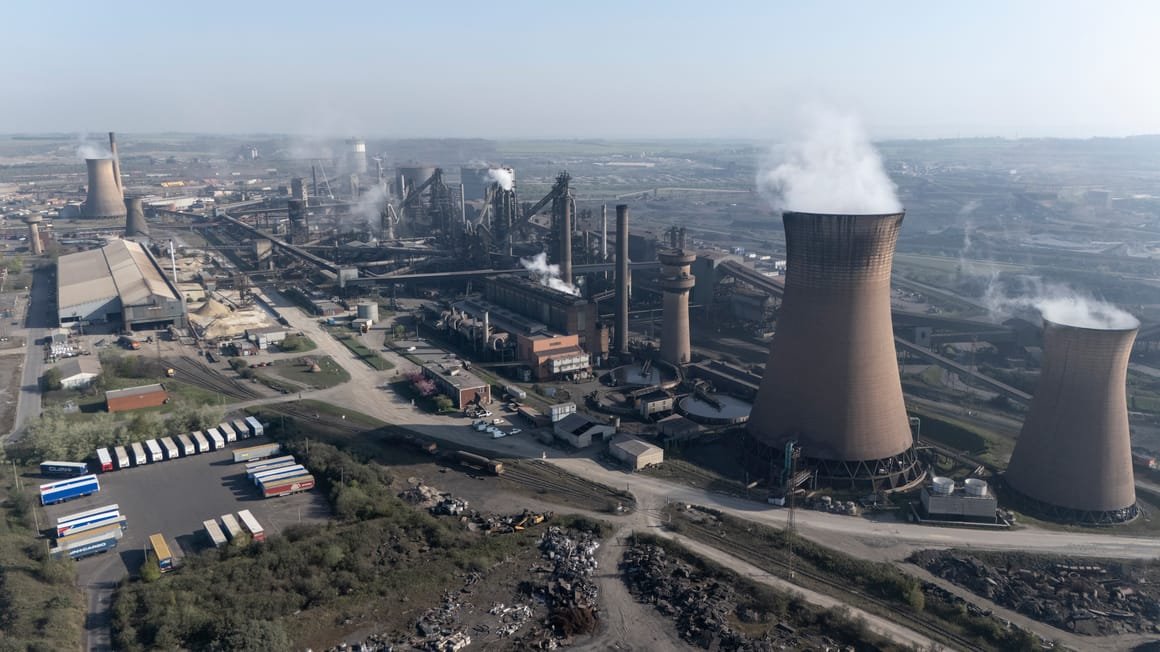
The British prime minister’s government dramatically took back control of the U.K.’s last virgin steel-producing plant from its Chinese owners this weekend.
After weeks of talks, parliament passed emergency legislation to wrestle the British Steel Scunthorpe site back from Jingye, with officials then racing to keep its crucial furnaces running after claims of neglect by the ousted owners.
It’s just one example of the ways the Asian giant has become deeply embedded in the British economy in recent years.
Ministers insist the British Steel intervention is a one-off — despite mounting calls from China hawks in the U.K. who want the reversal of the 2020 sale of the embattled steelmaker to be seen as a watershed moment.
British Steel “should mark the start of the strategic disentanglement of U.K. critical infrastructure from the Chinese state, reflective of the new geopolitical realities, » said Jaya Pathak of the Inter-Parliamentary Alliance on China (IPAC), a Beijing-critical group of lawmakers.
British Steel’s case is a dramatic one — but it’s far from unique. Starmer’s ambitions for growth envisage a wave of new wind farms, a push for nuclear power, a tilt toward tech and AI, and a drive for direct investment. On all these fronts, China — which on Monday warned Britain against « politicizing » the steel dispute — seems inescapable.
Green power
Decarbonization has been a key part of Labour’s plan since it won a landslide last year. But its drive for green energy leaves it grappling with the fact that China is already a global leader in cheap renewables.
Wind was the U.K.’s biggest source of electricity last year; globally China produces 70 percent to 80 percent of the core components used in wind farms.
So far it hasn’t made major inroads into the U.K.’s offshore wind sector, with farms typically built by other Europeans, and without using Chinese turbines. But that could soon change.
A planned floating offshore wind farm in the North Sea — Green Volt — is seen as a test case, with expectations that Chinese firm Mingyang will be confirmed as the turbine supplier. The same company plans to build a turbine factory in Scotland. Britain’s investment minister met with Mingyang in December.
Some security experts have raised concerns that using Chinese tech in European wind farms could even allow the owners to shut down crucial power supplies in the event of tensions with Beijing. Dan Marks, a research fellow for energy security at the Royal United Services Institute (RUSI) think tank, said the risk had to be taken “seriously,” but that the more immediate danger was that the U.K. and Europe had allowed China to double down on its supply chain dominance — and become indispensable to European energy security.
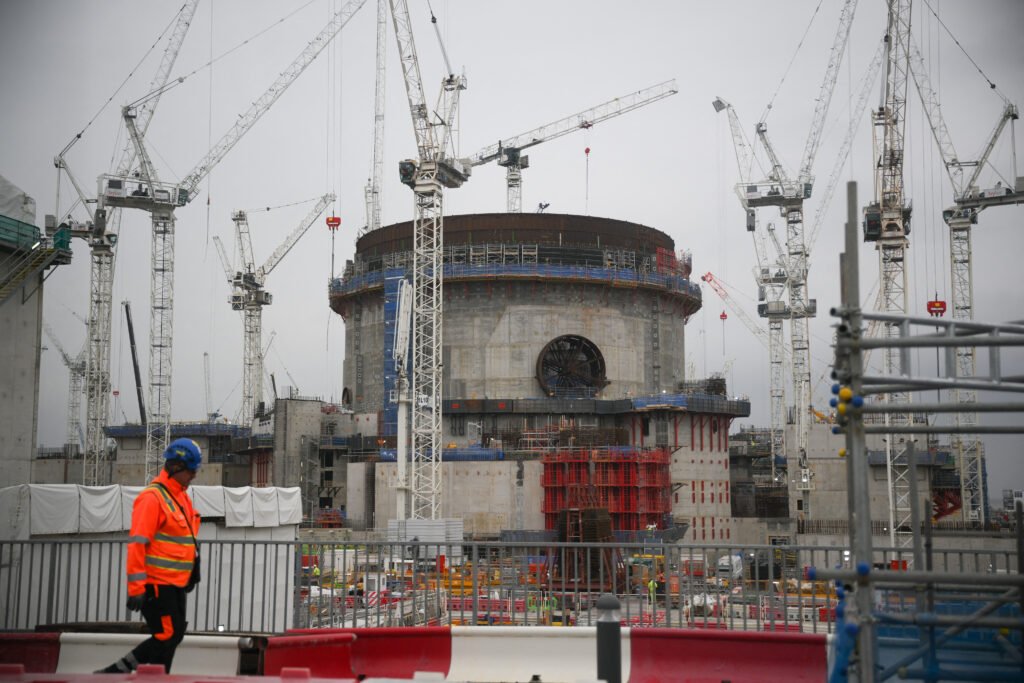
The government’s desperate three-decade struggle to revive the country’s aging nuclear fleet has left Hinkley Point C — a costly nuclear power station under construction on the north Somerset coast — still partly owned by state-backed investor China General Nuclear Power (CGN).
The company has a 27 percent share in the 3.2-gigawatt mega-plant, and 30 of CGN’s engineers are still working at the Somerset site, according to operator EDF. “CGN bring valuable experience to Hinkley Point C,” a spokesperson said. While CGN sustains a presence, they have stopped funding the power plant — even after ploughing £6 billion into the project before relations with the U.K. government soured — with EDF the only continuing financier of the site.
China’s status as the world’s second-biggest global economy has seen it utterly dominate other nations in resources and production.
Labour’s pledge to decarbonize the British power system by 2030 means building more solar farms in the next five years — which in turn means leaning more on China for raw materials like polysilicon, melted down as solar panels are produced.
China controls 80 percent to 85 percent of the global solar manufacturing market, according to a 2024 report from the Ember think tank, with millions of pounds of Britain’s solar sector now reliant on Chinese manufacturing. “I would frame it as an energy security vulnerability, because you’re relying on China for the continued construction, repair and maintenance of the solar panels,” said Andrew Yeh, executive director of the China Strategic Risks Institute, a Sino-skeptic think tank.
A 2023 report from RUSI found that China has a “near monopoly” on other rare-earth minerals used in the production of other net-zero technologies, such as magnets for wind turbines and electric cars.
Technology
China’s dominance of the global economy is also based on the success of its burgeoning tech firms. Britain’s ability to stay competitive in AI and other crucial technologies will mean keeping access to global supply chains in the years to come.
While most advanced AI hardware is currently produced in Taiwan, not China, the risk that a Chinese invasion could cut off exports from the island has encouraged the U.K. and allies to search for alternatives.
In 2021 the U.K. appeared to give up the fight by selling its biggest semiconductor factory to Chinese-owned Nexperia for £65 million, despite substantial security concerns. Two years later the government sold it off again to U.S. electronics giant Vishay, after forcing Nexperia to sell its stake following months of backlash.
This came alongside a decision to strip Chinese telecoms giant Huawei from Britain’s infrastructure over surveillance concerns. The reliance of Britain’s telecoms network on Chinese-made gear came to a head in 2019, with fears the tech could be used in espionage. The government said last month it now expected Huawei to be fully removed from 5G networks by 2027.
While the U.K. has not followed other countries in banning DeepSeek, the Chinese artificial intelligence chatbot that caused a mini-stock market crash earlier this year, government officials have probed it for security risks.
« Under China’s Cybersecurity and National Intelligence Laws, companies like TikTok and DeepSeek are required to hand over data to the state without transparency or accountability, » warned IPAC’s Jaya Pathak.
The issue isn’t just privacy — it’s strategic vulnerability. The U.K. has no way to verify how this data is used, while the Chinese state has unrestricted access.
Investment
As Starmer tries to woo investment in the sluggish British economy, he has to contend with a stark trade-off.
Splashing the cash in Britain often grants access to some of the country’s wealthiest and best-connected figures, with the information they divulge — unwittingly or not — helpful to China’s state-backed companies.
Chinese state-linked figures have gained access to top British universities, its MPs and even, apparently, its royal family in recent years. Two men, including one former parliamentary researcher, were charged with spying for China under the Official Secrets Act and are set to face trial later this year.
Britain’s security services have also been keeping a close eye on Chinese access to the U.K.’s top seats of learning, as British universities are increasingly reliant on fees paid by international students. MI5 Director General Ken McCallum has previously warned that hostile states were actively targeting universities to steal technology that can “deliver their authoritarian, military and commercial priorities.”
Walking the tightrope
Britain’s stance toward China might become clearer when the government finally completes a long-awaited “audit” of engagement with Beijing.
Recent events at Scunthorpe are not expected to make a material difference to the content, direction or tone of the China audit, two people with knowledge of the process said. And No. 10 Downing Street said on Monday that it had no plans to reassess Chinese involvement in other infrastructure projects.
This is partly because government officials believe they are already taking a cautious approach to critical infrastructure. Yet the audit is also said to have become a largely internal-facing process in Whitehall — one not designed to show a major change in the U.K.’s China policy. Expectations are also that large parts of its findings will remain secret.
The audit — which was delayed from earlier this year — is now well advanced and is still due to be published this spring, likely around June, two separate people with knowledge of the process said. This would mean it arrives before a proposed visit by Starmer himself to China, drawn up for some time after summer 2025.
But its formulation has also been heavily influenced by Chancellor Rachel Reeves, who visited China in January to drum up Chinese investment in Britain.
This same Whitehall tug-of-war between “securocrats” and growth has snagged a second U.K. policy — the Foreign Influence Registration Scheme (FIRS), a public register of the activities of hostile nations in Britain, which will launch in July after long delays.
Russia and Iran have already been placed in an “enhanced tier” of FIRS reserved for countries and groups that pose a significant threat to national security. But ministers have still not agreed whether to place China in that tier, a U.K. official with knowledge of the talks said. The policy is led by the Home Office, but China’s potential inclusion led to heavy lobbying from the financial sector.
POLITICO reported last month that the Chinese state as a whole would likely be kept out of the enhanced tier — but this week, the official quoted above stressed that plans remained a “movable feast” and that several options were still open. These include adding Chinese individuals or firms, as POLITICO reported, or parts of China’s security apparatus, as the Guardian wrote this week.
“That the government seems reluctant to include China in the enhanced tier of FIRS is deeply concerning, both for monitoring but also public signaling of the threat [that] engagement with China represents,” said IPAC’s Jaya Pathak.
This week’s events serve as a stark warning about Britain’s reliance on China.
But Starmer’s government also knows that — just as with Donald Trump’s new U.S. administration — there are some economies that are simply too big to ignore.
Joseph Bambridge, Sophie Inge and Dan Bloom contributed reporting.