The eligibility ban on presidential hopeful Marine Le Pen and the market-wrecking tariffs of U.S. President Trump are just the latest challenges roiling Emmanuel Macron’s second term.
PARIS — Emmanuel Macron’s terrible, horrible, no good, very bad week began with his far-right rival taking a flamethrower to a pillar of French democracy, and ended seven days later with his country’s main stock index plunging deep into the red.
But Marine Le Pen’s ban on running for office and Donald Trump’s market-wrecking tariffs are just the latest challenges threatening to upend the French president’s second term.
A trade war brews to the west whilea real warrages to the east. Parliament is hopelessly fractured. France’s budget deficit remains stubbornly high, with little prospect of bringing it down beyond painful spending cuts or tax hikes that suffocate growth. Meanwhile, the country’s fourth prime minister in the last 18 months, François Bayrou, might be on his way out if far-right lawmakers make good on recent threats to bring down the government.
The pillars of France’s 66-year-old Fifth Republic appear fundamentally ill-equipped to withstand this unprecedented onslaught of domestic and international crises.
Macron’s room for maneuver is curtailed, his prime ministers are vulnerable, and workable majorities seem elusive. The president has few options to remedy the political deadlock beyond calling another snap election this summer, which could end up delivering yet another hung parliament.
“Things are bad. Things are really bad right now,” Bruno Cautrès, a political analyst at the Sciences Po Centre for Political Research in Paris, said last week — before global stock markets, including France’s benchmark CAC40, plummeted as a result of the Trump tariffs.
Monday’s market downturn could be a sign of even worse to come, a Macron ally who was granted anonymity to discuss a sensitive topic told POLITICO.
“When it [the crisis] starts hitting the real economy, and companies start seeing order books being slashed, it’s going to get really complicated,” the ally said.
What’s wrong with France
Once viewed as a commanding force in politics, Macron is now trusted by just one in four people in France to tackle the problems facing the country.
His decision to raise the retirement age despite widespread opposition repelled much of the voting public. His decision to call a misguided snap election last summer delivered a divided parliament that further impacted his credibility.
Few voters now believe he can defuse another parliamentary crisis, let alone take decisive action on the war in Ukraine or rein in Trump’s protectionist instincts.
For Cautrès, Macron’s missteps have fueled public frustration with politics, including his appointment of unelected prime ministers and his refusal to let the left coalition, the largest in the parliament, run the country. Meanwhile, as the far right keeps winning elections but is systematically barred from power, the question arises: Does France’s democracy still work?
Only 28 percent of French poll respondents believe their democracy works well, far lower than in Italy, the Netherlands and even Germany (51 percent), according to a study conducted by the Sciences Po facility.
“The dissatisfaction is gigantic and it’s not just among [radical forces like] the National Rally and the France Unbowed party,” Cautrès said. “There’s a general feeling that [French] democracy is dysfunctional.”
The rage of Le Pen
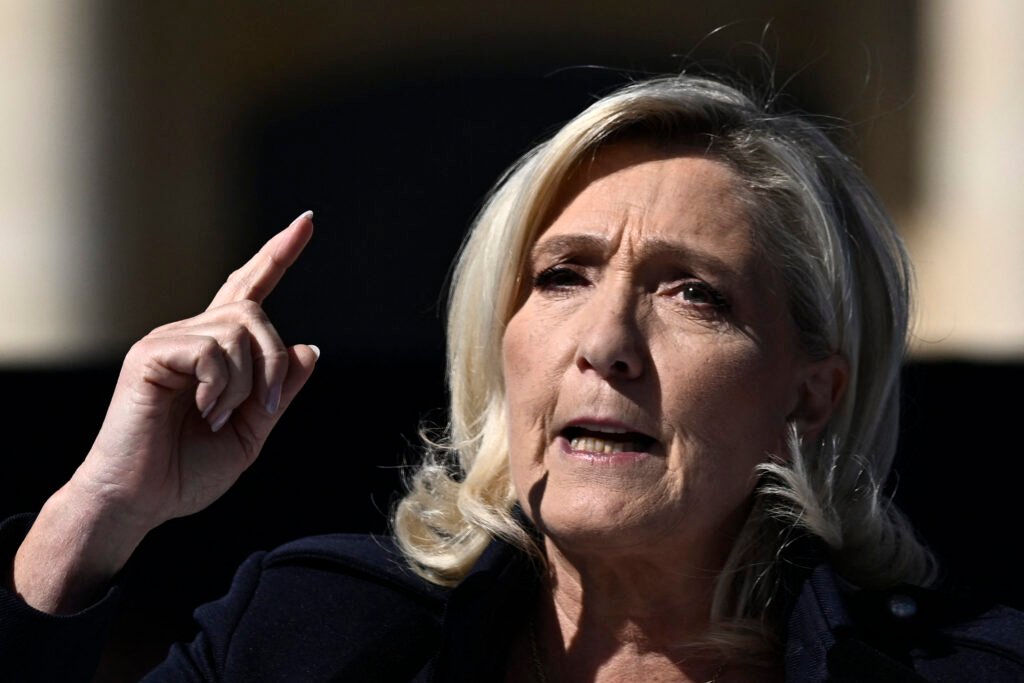
Before March 31, Marine Le Pen appeared to be the opposition leader best placed to take advantage of France’s enduring political malaise. Her far-right National Rally movement remains the biggest single party in the National Assembly, France’s more powerful lower house of parliament, and is enjoying unprecedented support. Polling shows Le Pen is the front-runner for the presidency in 2027 were she to run.
Last week, however, Le Pen, her party and 23 of her far-right allies were found guilty of misappropriating more than €4 million in European Parliament funds. A three-judge panel took the extraordinary — though not unprecedented — decision to immediately ban her from running for office for five years, rather than delaying the punishment until the appeals process plays out, as is usual in France. The decision effectively bars Le Pen from standing in the 2027 presidential election, unless it is overturned on appeal.
In response, Le Pen has unleashed an almighty attack on a what she sees as a system and a judiciary rigged against the National Rally, a strategy that threatens to erode confidence in France’s democratic system.
“This judgement will further polarize French society, which is already divided and which will become more divided,” said Alberto Alemanno, a EU law lecturer at HEC business school in Paris.
Among the problems facing the French political establishment is that while the evidence against Le Pen is compelling, there’s a grain of truth in her claims that “the system” is against her. The far-right leader has routinely struggled to get bank loans to fund election campaigns or to get the backing of enough officials to run for office, while the so-called Republican Front sees parties that have little in common uniting merely to keep the National Rally from power.
Even Le Pen’s political adversaries have questioned whether the court erred in barring her from the 2027 election, though their critiques have been of the decision itself and remain a far cry from the full-throated attacks on the independent judiciary coming from the National Rally. The current justice minister said in November, before he took up his post, that it would be “shocking” if Le Pen was handed an eligibility ban and that she should be defeated “at the ballot box, not elsewhere”
Forty-three percent of French respondents disagreed with the decision to bar Le Pen from running in the next presidential election, according to a Cluster17 poll. That’s roughly the same share of the electorate that voted for the far-right leader in the second round of the 2022 presidential election.
The next crisis
There is no shortage of potential flashpoints on the horizon. A government collapse, a financial crisis or even a return of the farmers’ protests all loom large.
Respected editorialist Alain Duhamel told Le Monde that France is living through “the greatest political crisis of the Fifth Republic.”
“Never has a President of the Republic been seen as so weakened in his possibilities of real political influence. Never have we seen prime ministers so fragile that they are seen as short-lived as soon as they enter the Matignon [the prime minister’s residence]. Never has a National Assembly been seen as so ungovernable,” Duhamel said.
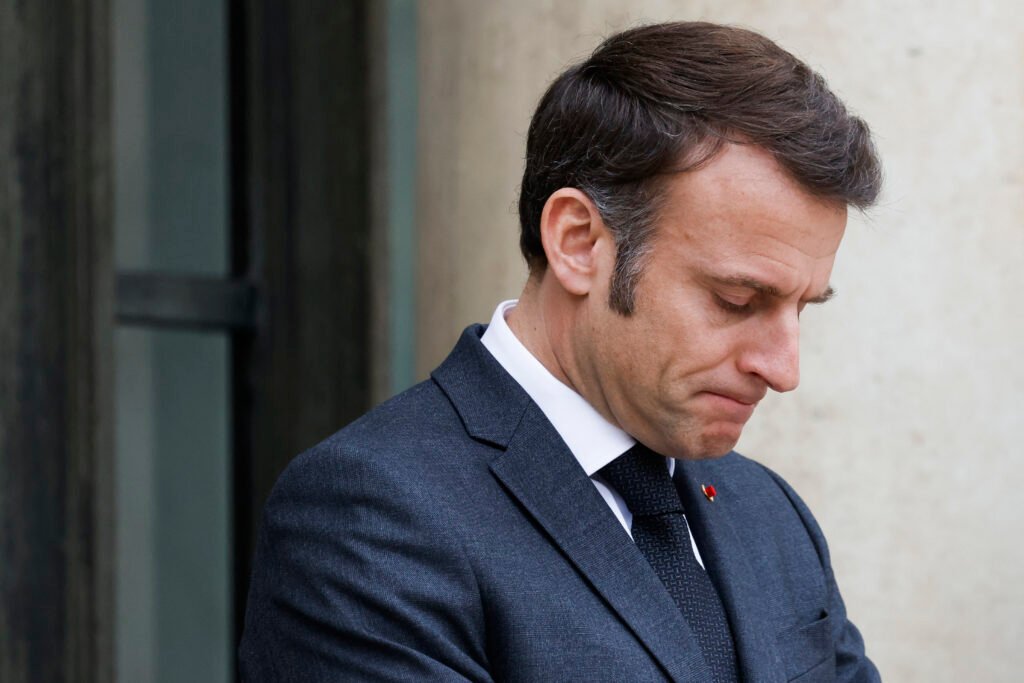
Macron’s successive governments have managed to put out fires by loosening the purse strings, but that option is probably off the table given France’s debts and plans to invest billions in defense spending.
“We are on the verge of being downgraded from AA to A [credit rating]. At that level, a lot of investors will no longer be formally allowed to lend to us,” said a French government official who was granted anonymity to discuss a sensitive topic.
Bayrou, the prime minister, has a reputation for being a procrastinator who postpones action to avoid confrontation. But the dire state of public finances is an issue he — or his successor — won’t be able to ignore forever. The same government official said that drawing up a 2026 budget would very complicated given the effect of Trump’s tariffs and France’s public debt, which hit €3.2 trillion last year.
“We’ll soon be spending €100 billion in borrowing costs per year,” the official said. “It’s dizzying.”
Nicolas Barré and Marion Solletty contributed to this report.