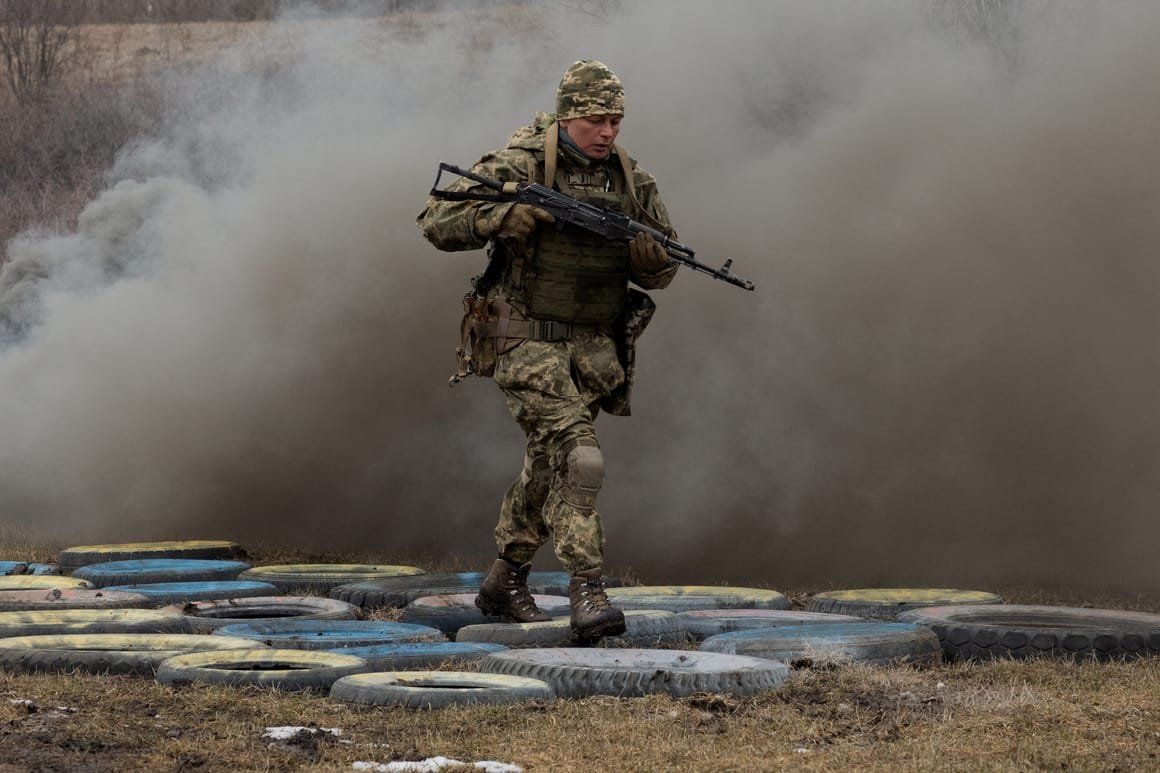
Ukraine’s supporters promised a record new round of military aid.
Peace in Ukraine is “out of reach in the immediate future,” German Defense Minister Boris Pistorius warned Friday as allies pledged a record €21 billion in new military aid to Kyiv.
Pistorius said that “Russia needs to understand that Ukraine is able to go on fighting, and we will support it,” after a meeting of the Ukraine Defense Contact Group — a format that organizes military aid for Kyiv.
The record pledge of military assistance includes £4.5 billion which the U.K. has committed for this year, as well as a further €11 billion from Germany.
The summit, held at NATO headquarters in Brussels, was hosted jointly by Germany and the U.K. after the U.S. abandoned its leadership of the group following Donald Trump’s return to the White House.
Despite that shift, U.S. Defense Secretary Pete Hegseth participated via videolink, and Ukrainian Defense Minister Rustem Umerov insisted America was still seen as a “prime partner” in the fight against Russia.
But there was broader concern about the future of the U.S. security role in Europe.
Pistorius stressed the need for the continent to “look on our own at what we can do” and « take on more responsibility as Europeans together with the U.K.”
Trump has promised to rapidly end the war in Ukraine, but Russia has balked at agreeing to a temporary ceasefire, instead continuing to attack Ukraine while launching a larger spring offensive.
The Trump administration is trying to get the Kremlin to shift, sending U.S. special envoy Steve Witkoff to Moscow on Friday, Russian state media reported. It is not yet clear if he will meet Russian leader Vladimir Putin.
Umerov said that Trump wants a ceasefire, and that he hoped to hear an update on the meeting soon.
U.K. Defence Secretary John Healey accused Putin of “continuing to drag his feet and delay negotiations” on the partial ceasefire proposed by the U.S. and agreed by Ukraine a month ago.
“Putin said he wanted peace, but his forces continue to fire on Ukraine, military and civilian targets alike,” Healey added.
The British defense secretary also responded to complaints of a lack of clarity over plans to provide security to Ukraine in the event of any ceasefire by another grouping of allies minus the U.S. — the so-called coalition of the willing — which met in Brussels on Thursday.
“Our planning for the coalition of the willing is indeed real, substantial, well-advanced,” Healey said.
On Thursday, Healey told allies that their peacekeeping efforts will center on providing air and maritime support, while maintaining “peace on the land” with a focus on helping Ukraine’s own forces, in a shift away from talk of sending ground troops from European countries to police the peace.
The U.K. earlier gave details of new support worth £450 million for Ukraine, about £350 million of which will be provided by Britain, with extra funding from Norway via the U.K.-led International Fund for Ukraine.
It includes £160 million to provide repairs and maintenance to vehicles and equipment the U.K. has already provided Kyiv.
Funding for radar systems, anti-tank mines and hundreds of thousands of drones worth more than £250 million is also part of the package.
The German defense ministry said that Berlin’s package included guided missiles as well as 100,000 rounds of artillery ammunition, 300 reconnaissance drones, 25 Marder infantry fighting vehicles, 15 Leopard 1A5 main battle tanks, 120 Manpads ground-based air defense systems and 14 artillery systems.
Germany is also pledging longer-term support, including 1,100 additional ground surveillance radars and further IRIS-T air defense systems in the coming years.
“We need a militarily strong Ukraine,” Pistorius said.