As coalition talks look set to return the country’s first far-right chancellor since World War II, the European Commission is warning about its finances.
BRUSSELS — The European Commission’s austerity police is set to deliver the latest challenge to Austria’s government-in-waiting as it readies a verdict on whether a plan to cut national spending is radical enough.
The outcome will not only chart the Alpine nation’s financial course but also shape the European Union’s relationship with what’s likely to become the country’s first far-right-led government since World War II.
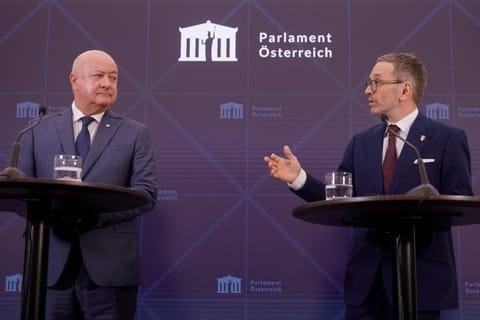
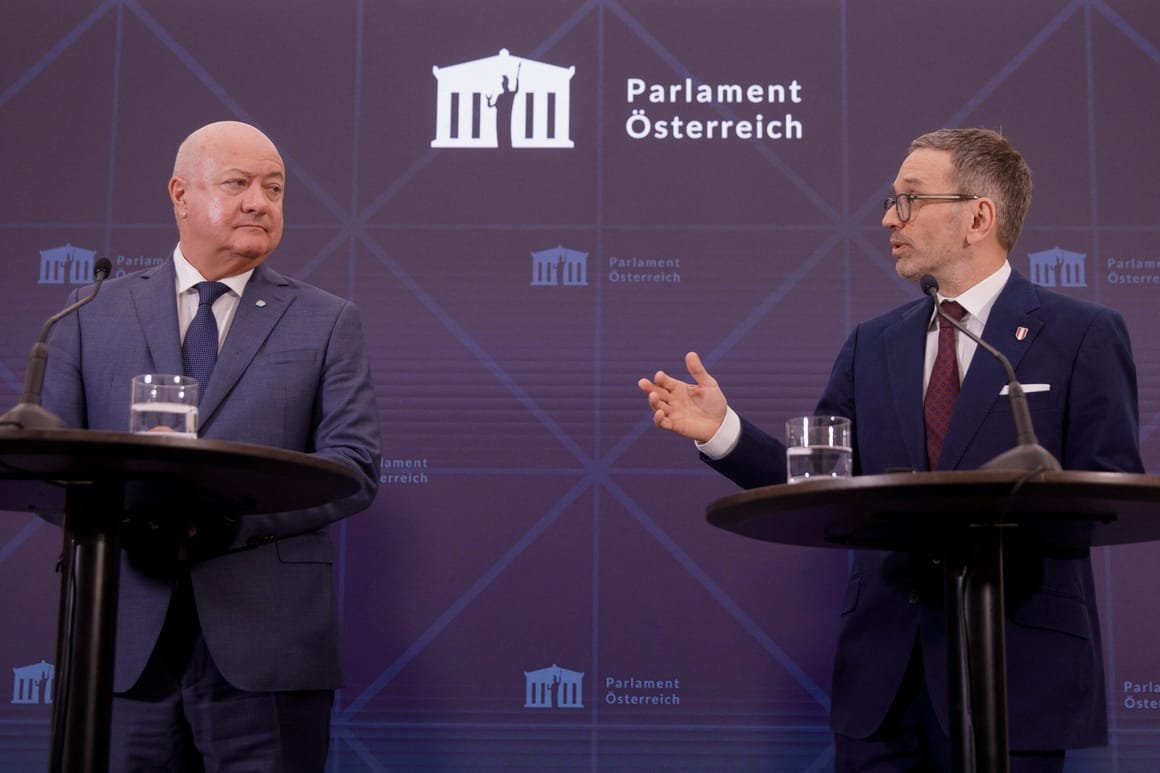
The far-right Freedom Party (FPÖ), whose leader Herbert Kickl is the favorite to become chancellor, and the center-right People’s Party (ÖVP) are on the brink of an historic agreement that is already sending shockwaves through Brussels and beyond.
The Commission — which runs the rule over the budgets of EU governments — is expected to announce its decision on Wednesday, and it could put Austria in the naughty corner for overspenders.
The executive is legally bound to decide whether to open a so-called excessive deficit procedure by the end of January.
In a last-ditch effort to avoid this, outgoing Finance Minister Gunter Mayr, a former Treasury official with no political affiliation, was scheduled to hold discussions with EU Economy Commissioner Valdis Dombrovskis in Brussels on Tuesday to present the economic plan that was agreed in Vienna.
Austria already got extra time
As coalition negotiations continue, mainstream parties worry that the FPÖ’s Russian sympathies and anti-migrant rhetoric will further tilt the EU’s center of gravity toward extremist positions that were until recently seen as beyond the pale.
Once praised for its fiscal orthodoxy, Austria’s deficit — the difference between how much a country spends and how much it brings in — is set to exceed the EU’s target of 3 percent of gross domestic product from 2024 to 2026.
While this would normally warrant the EU’s punishment for overspending countries, the Commission delayed the process in November to give Vienna extra time to get its house in order.
A triggering of the EDP mechanism would entail more drastic budget cuts for Austria — which is already facing sluggish growth — and, embarrassingly, place the country in the same category as highly indebted Italy and France.
Responding to the mounting pressure from Brussels — even as the broader government negotiations remain unresolved — the FPÖ and ÖVP on Monday unveiled a deficit-cutting proposal they hope will be enough to dodge an EDP outcome.
Both parties’ leaders agreed to spending cuts of up to €6.3 billion to get the deficit below the EU’s 3 percent limit in 2025. This will ensure that Austria is “stabilized financial[ly] in the long term,” Kickl and ÖVP leader Christian Stocker wrote on Monday in a letter addressed to Mayr seen by POLITICO.
They also agreed that Austria would seek EU approval to stretch its fiscal consolidation program from four to seven years to ease the burden of spending cuts.
If the Commission deems these measures insufficient, Austria will be legally obliged to undertake billions of extra cuts in the coming years under an EDP.
The Commission will officially respond to the measures on Wednesday during its first weekly meeting of the year. The meeting is set to be overseen by Executive Vice President Teresa Ribera due to the ill health of Ursula von der Leyen, who is still recovering from pneumonia.
The EU’s finance ministers will then vote on the Commission’s resulting recommendation the following Tuesday.
Oliver Noyan contributed to this report.