


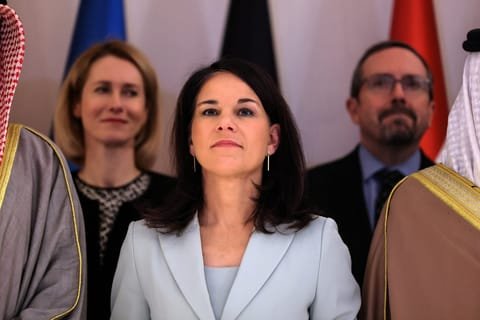

Syria’s transitional government “sounds good so far,” Germany’s foreign minister told POLITICO — but actions speak louder than words.
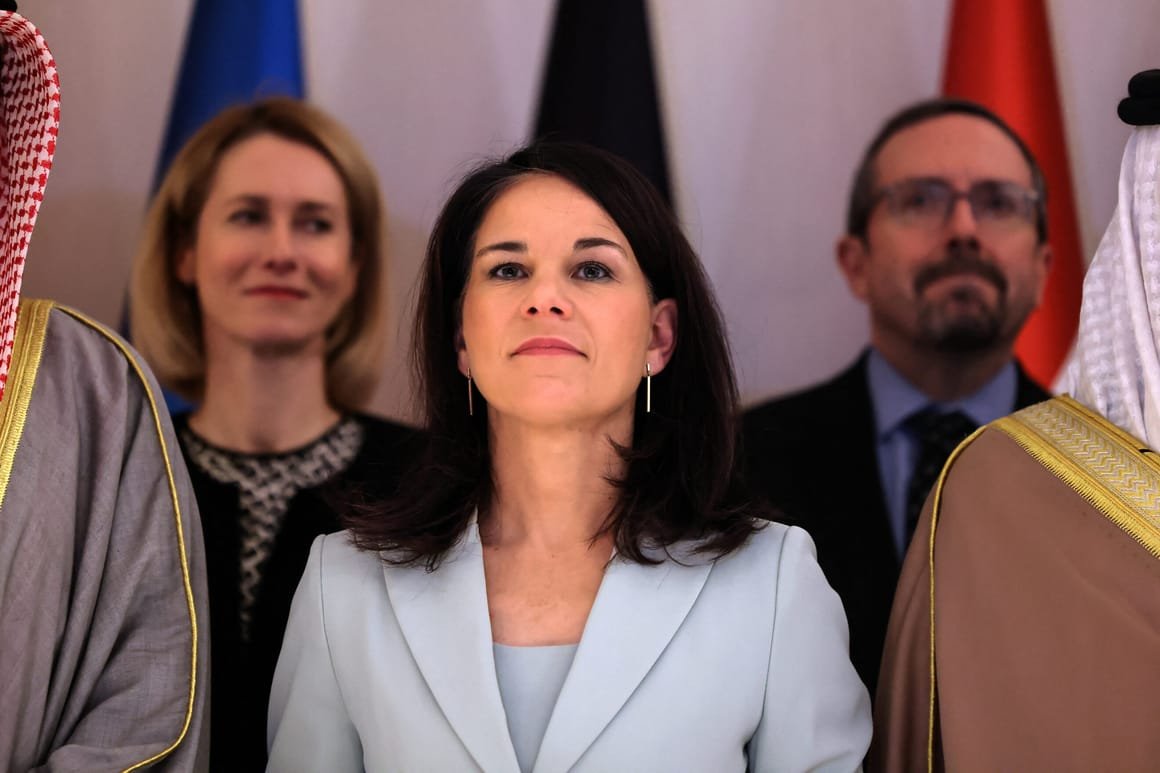
German Foreign Minister Annalena Baerbock warned that regional actors such as Turkey and Israel could threaten Syria’s fragile peace, as European and Middle Eastern envoys met in Riyadh on Sunday to discuss lifting EU sanctions.
“Turkey is pursuing its own security policy. I’m in intensive talks with Israel to convince them to stop their military actions there,” Baerbock told POLITICO in an interview. “And then, as I said, there are still all these other militias on the ground that have brutally exploited the past years of civil war.”
Baerbock, who visited Damascus on Jan. 3, said there were positive signals from Syria’s new rulers, saying their pledge to include “all actors” in the country’s political transition “sounds good so far” — but it still remained to be seen if they would follow through.
“Whether this will be successful is in the hands of this transitional government,” she said.
“We must constantly remind ourselves that, yes, this is a terrorist militia,” she added, referring to Hayat Tahrir al-Sham (HTS), the al Qaeda breakaway that took control of Syria in a lightning offensive last month, ending half a century of rule by the Assad family.
HTS is joined by collections of Turkish-backed militias called the Syrian National Army, forming a complex grouping with competing interests.
Baerbock attended a gathering in Riyadh on Sunday along with the EU’s top diplomat Kaja Kallas and European and Middle Eastern diplomats to discuss sanctions relief ahead of a meeting of EU foreign ministers in Brussels on Jan. 27.
“We will be looking at how to ease sanctions,” Kallas wrote on X, confirming Syria’s sanctions would be on the agenda for the foreign ministers. “But this must follow tangible progress in a political transition that reflects Syria in all its diversity.”
The Riyadh meeting saw a coalition of EU countries — France, Germany, the Netherlands, Spain, Finland and Denmark — call for the EU to drop its sanctions on Syria, paving the way for a formal decision to lift restrictions at the Jan. 27 meeting.
A paper signed by those countries, obtained by POLITICO, focuses on transport between the EU and Syria, removing a ban on the export of oil and gas technology and reopening banking and investment relations.
Bashar al-Assad was in power for almost 25 years and his family ruled Syria for more than half a century. His Iran- and Russia-allied regime brutally curtailed human rights, deploying chemical weapons against civilians as part of the civil war that has raged in the country since 2011.
Millions of displaced Syrians currently live in the EU, where many countries have paused asylum applications in the wake of the Assad regime’s fall. At least one country, Austria, said it was planning to deport Syrians.
Baerbock said stabilizing Syria’s political situation was important “to make sure that those who fled violence and terror can one day return and live safely in their homeland.”