
Tarragona’s beaches are covered with plastic pellets, highlighting a Europe-wide problem that is the focus of EU interinstitutional talks.
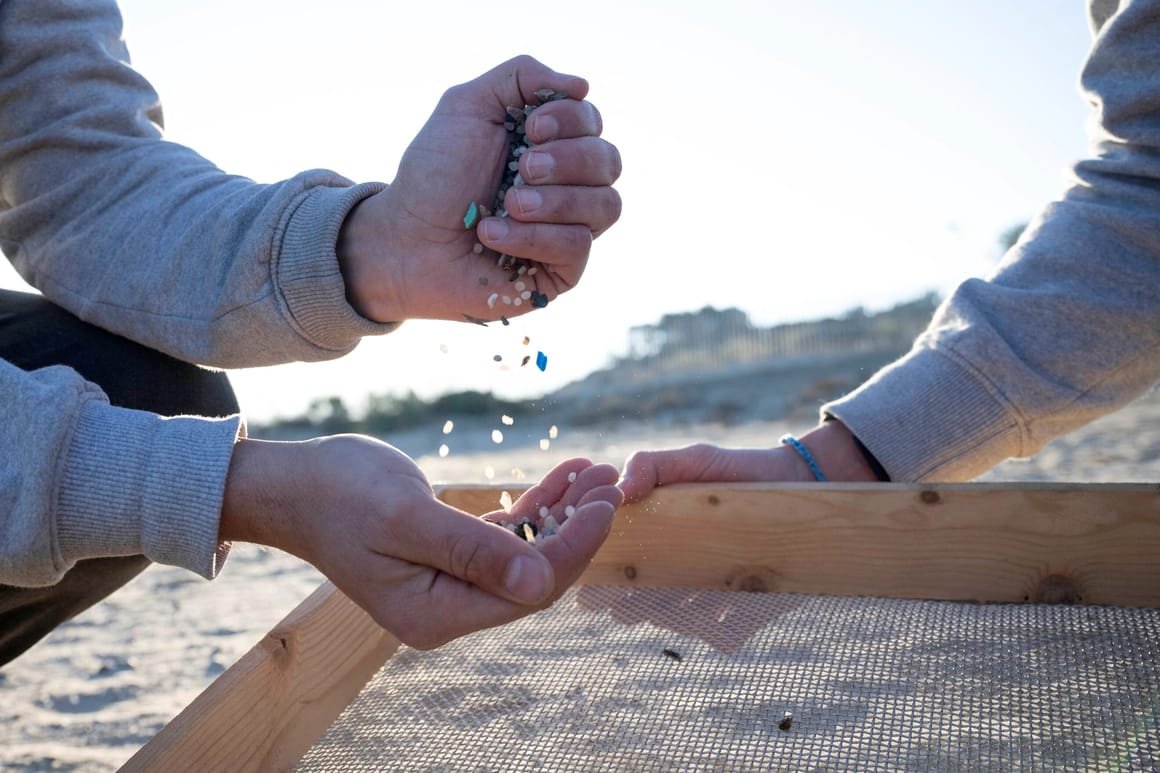
TARRAGONA, Spain — European lawmakers this week started talks on how to solve an insidious facet of the plastic pollution crisis — one that’s a brute reality for the Catalan province of Tarragona.
The seaside community on Spain’s Costa Dorada has become an emblem for the plastic pellet pollution crisis. Housing one of the largest petrochemical clusters in southern Europe, Tarragona’s beaches are dotted with the small plastic beads that resemble grains of Arborio rice. Known as pellets, these are the building blocks for nearly every plastic product in the world.
« We are in the Champions League of pollution, » said Joaquim Rovira, a chemist at Tarragona’s Rovira i Virgili University who has written extensively about pollution in the region. « I’m not against these companies … but produce in a way that is sustainable. »
Between 52,000 and 184,000 metric tons of the mini plastic balls are released into the environment in Europe each year due to mishandling throughout the entire supply chain, according to the European Commission.
A trip down to Tarragona’s Pineda beach lays bare the problem: You can run your fingers through the sand and grab the plastic beads by the handful. But the pellets aren’t just a vacation-dampener. Once in the environment, they do not biodegrade, accumulating in animals such as fish and shellfish and contributing to microplastic pollution.
But as things stand, this extreme level of pollution is no one’s responsibility. Tarragona’s Public Prosecutor’s Office has repeatedly — on three separate occasions — tried and failed to determine criminal liability for the pollution.
It’s far from an isolated problem. A ship spillage of pellets in the Atlantic last year sparked a fresh ecological, and political, emergency in the north of Spain. In 2020, a major spill saw 10 tons of pellets released into the North Sea, with millions showing up on the coastlines of Norway, Sweden and Denmark. Another spill just above the Dutch island of Schiermonnikoog wreaked havoc on marine organisms in the North Sea and the Wadden Sea. And in 2022, hundreds of thousands of white plastic pellets of unknown origin began washing up on beaches in France and Spain.
Now European lawmakers are trying to work out how best to solve the European Union’s plastic pellet problem without kneecapping its plastic industry.
« I fully understand the frustration and concern of the residents of Tarragona, » said Spanish Socialists and Democrats lawmaker César Luena, who’s leading work on the dossier for the European Parliament. « The European Parliament is working to ensure stricter regulation and to hold those responsible for pollution accountable. »
The mayor of Vila-seca — home to the Pineda beach — Pere Segura, in an interview with POLITICO called on EU policymakers to be “courageous.” New rules would not be a “frontal attack on a product such as plastic,” he said, but should ensure “we do not have contamination in environments where there should be no plastic.”
The city where plastic reigns
Driving around the Tarragona petrochemical complex, one might expect to see plastic pellets bouncing around and spilling out from factories, given their prevalence on nearby beaches.
In fact, POLITICO saw a handful of pellets lying by the side of roads, encrusted in nearby drains and nestled in between pebbles in the dirt, but nothing like the quantities seen on the sands of the Pineda beach.
Pellets are often blown or washed into the sewage system, explained engineer Jordi Oliva Farriol — co-founder of the local Good Karma Projects NGO — especially on rainy days, before being carried into the sea, then washing up on the beach.
That makes it even harder to establish the precise origin of the pellets. Tarragona’s Public Prosecutor’s Office opened investigations into the pellet pollution in 2019, 2021 and 2024. All of them were closed due to a lack of evidence needed to establish criminal liability.
Rovira, the chemist, says there’s not too much public outrage about that. The plastics industry is in the DNA of the city. The Tarragona petrochemical site — which dates back to the 1960s — directly employs 5,500 people and generates more than 40,500 jobs in related activities, according to the European Chemical Industry Council. The population of Tarragona city is just over 140,000. Plastic pellet producer Repsol sponsors the Tarragona football team Gimnàstic de Tarragona. Dow finances a local annual « festa. »
Rovira’s father worked for one such company. That money put Rovira through university, he said, culminating in a PhD that, ironically, he now uses to research pollution from the Tarragona petrochemical industry.
« I’m not the only case of contradiction in that way, » he said.
Pollution without borders
Industry bodies argue plastic manufacturers aren’t twiddling their thumbs and doing nothing. The Operation Clean Sweep program is a voluntary, industry-led initiative to prevent the « unintentional release of plastic particles into the environment at any stage of the plastics value chain. » Dow, for example, proudly inaugurated a « blowing tunnel, » designed to prevent trucks from losing pellets.
Asked for comment, plastic manufacturers directed POLITICO to the Chemical Companies Association of Tarragona, that said Tarragona’s chemical sector has been « proactive and determined from the outset to seek solutions to the pellet problem, » pointing to the Operation Clean Sweep program as proof.
« Most of the companies in [the pellets value] chain are not part of the association and [do] not adhere to the OCS certification, which we consider to be the best tool available to ensure that there is no unintentional release of pellets outside the facilities, » it added.
Still, they continue to make their way into the environment in Spain and beyond.
The Catalan Department of Climate Action, Food and Rural Agenda in August concluded for the first time that the responsibility for the pollution is « collective, » establishing a « causal link between the pollution and the activity of a dozen companies » including Basell Poliolefinas Ibérica, Dow Chemical Ibérica and Repsol Química.
The Catalan climate department couldn’t demand joint compensation from them, it said, due to blurred lines on who can be held legally responsible and a lack of clarity over when the pellets were emitted.
That’s why the EU institutions are in talks to work out how to « strengthen the regulatory framework to ensure greater clarity and responsibility in all aspects related to plastic pellet pollution, » said Luena, the member of the European Parliament.
The Parliament is pushing for more restrictive legal obligations on companies than EU countries — making it a fault line in the talks. EU plastics lobby Plastics Europe is counting on EU countries to stand firm: Alexander Röder, climate and production director of Plastics Europe, said the lobby is “concerned that the European Parliament is looking to pursue a more prescriptive approach on technical pellet loss prevention measures.”
NGOs have applauded MEPs for “going the extra mile” and hope the final text will regulate the maritime transport of plastic pellets.
« We need the support of all involved actors, including local authorities, to ensure that European efforts are complemented by concrete and effective actions in Tarragona, » said Luena.